
The Untapped Local Opportunity
In most of the United States, the professional tote rental market is still in its infancy. While major cities have a few players, the vast majority of local markets are completely underserved. This represents a massive opportunity for local entrepreneurs to step in and own their territory.
Unlike most physical businesses, the entry cost here is remarkably low. You don't need a warehouse, a fleet of trucks, or a massive staff to start. You can launch with a small batch of high-quality totes and a reliable digital system, scaling your inventory only as your revenue grows.
Step 1: Build a simple equipment rental business plan
Founder to founder: avoid overcomplicating your first 90 days. Your job is to prove local demand and protect your cash. Keep your plan focused on three numbers:
- Cost per tote fully delivered.
- Average rental price per turn.
- How fast each tote turns in your market.
Typical startup cost buckets
- Inventory: Heavy-duty totes and tote dollys.
- Drop-off setup: straps, dolly, and simple route fuel budget.
- Legal & Administrative: LLC filing, tax registrations, and government paperwork.
- Brand basics: logo, booking page, and customer receipts.
- Operations system: tracking from day one.
Step 2: Source inventory like an operator, not a hobbyist
Your first 100 totes do not need to be brand new, but they must be consistent. Look for clean, high-quality totes that are free of any odors or industrial residue. Avoid totes that have held chemicals or oils, as these are nearly impossible to clean to a residential standard.
Step 3: Avoid the spreadsheet trap before it starts
In the beginning, tracking 100 totes in a spreadsheet feels easy. By tote 200, you will find yourself caught in a constant loop of manual reconciliation—updating rows, searching for customer numbers, and typing out the same reminders over and over. This is the "Admin Tax" that kills the momentum of a growing startup.
Digital tracking from day one gives you:
- Quick-Action Messaging: Tap a button to send a pre-written message to the customer instantly—no searching for numbers or typing on the fly.
- Digital Proof of Drop-off: Snap a photo on your phone and attach it to the order instantly.
- Conflict-Free Scheduling: Never double-book a tote again because you forgot to mark a return as "Pending."
The Day-to-Day: A 2-Hour Workflow
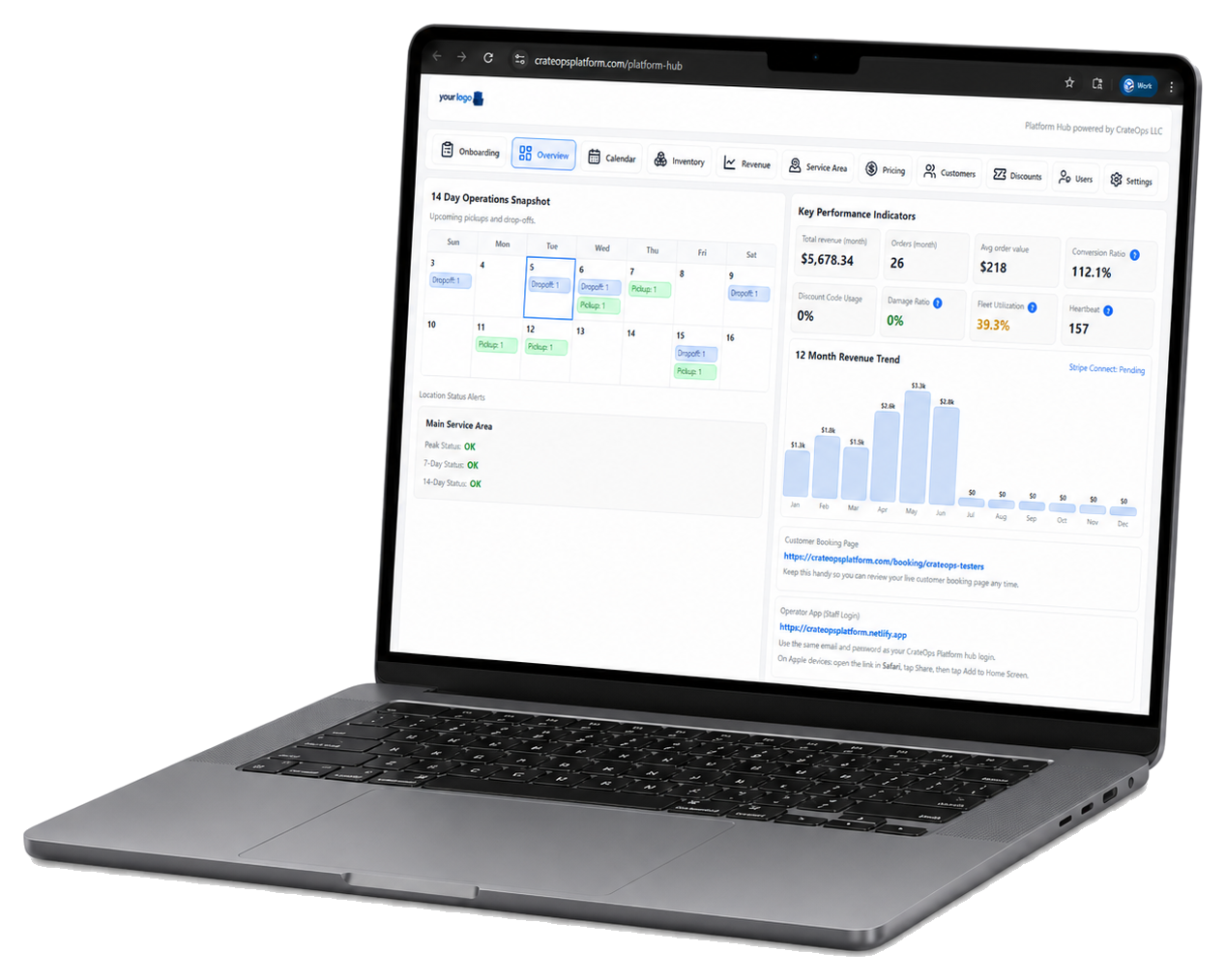
A typical day for a CrateOps operator isn't spent behind a desk. It's spent in the field. Morning route reviews take 15 minutes to see what's going out and coming in. Drop-offs and pick-ups are routed automatically, and confirmations happen with a single tap on your phone at the customer's doorstep.
CrateOps provides the underlying engine that makes this possible, turning a complex logistics challenge into a streamlined, business-in-a-box workflow.